
Why It's So Hard to Say What You Mean, And What to Do Instead
You know what you want to say. You can feel it, clear as anything, in the moments before the conversation starts. And then you're in the room, and something else comes out. A softer version, a vaguer version, sometimes nothing at all.
If this sounds familiar, you're in good company. I see it constantly in my office: people who are articulate, capable, and self-aware in every other part of their lives, who go quiet exactly when it matters most.
I was prompted to write this by a piece in Krista Berlincourt's newsletter Life, Death, All Of It, which describes two accomplished executives who knew exactly what they wanted and still couldn't ask for it. Her framing stuck with me, because it names something I think about often in this work. The gap between what we feel and what we say isn't a communication problem. It's a nervous system problem.
Why your words disappear when it matters most
Here's what I want you to understand first. If you've ever sat across from someone important, whether a partner, a boss, or a parent, and felt your throat tighten or your thoughts scatter right as the real conversation began, that wasn't a failure of nerve. That was your nervous system doing exactly what it's built to do.
We are wired, long before we have language, to track one question above all others. Am I still safe here? Am I still wanted? For most of us, that wiring was shaped early, in families where certain feelings were welcome and others weren't, where speaking up led to connection or led to distance. By the time we're adults negotiating a job offer or telling a partner something hard, that old circuitry is still running in the background. The stakes have changed. The wiring hasn't. Often, the anxiety in the room isn't really about the room.
So when something genuinely matters, when there's real risk of disappointing someone, of being seen as too much or not enough, of disrupting a relationship you depend on, the body responds the way it always has. It contracts. It goes quiet. It reaches for the smaller, safer version of the truth, because some old part of you learned that the smaller version was the one that kept you connected.
This is why willpower so rarely fixes it. You can know exactly what you want to say and still not be able to access it, because the part of you doing the talking isn't the part running the show in that moment. The fear arrives first. The words arrive, if they arrive at all, somewhere underneath it, hedged and softened past recognition.
It's the same reason understanding a pattern doesn't dissolve it. You can have perfect insight into why you go quiet and still go quiet.
The cost of staying quiet
What makes this pattern so persistent is that it usually works, at least in the short term. Staying vague keeps the peace. Going along avoids the conversation you're dreading. Nobody gets upset.
Berlincourt makes a point I keep returning to: silence gets mistaken for agreement when what it actually is, underneath, is fear of losing belonging.
That substitution has a cost. Every time we choose the smaller, safer version of what's true, we're teaching the people around us, and ourselves, that the smaller version is the real one. Over time, the gap between what we feel and what we express doesn't stay neutral. It becomes the relationship. The resentment that seems to come out of nowhere, the slow drift in a partnership, the sense of being unseen even by people who love you: much of this traces back to a thousand small moments of going quiet instead of going honest.
It also has to go somewhere. What doesn't get said tends to come out sideways, in tone, in withdrawal, in the disproportionate reaction to something small three weeks later. I've written about what happens to anger that never got to speak, and this is where a lot of it starts.
This is true for individuals and it's true for the systems we're part of. Berlincourt cites Eric Ries's book Incorruptible on how organizations shrink their desires and soften the principles they once decided from, in order to maintain belonging in a market. Whether it's a couple avoiding the real conversation, a family organized around one person's comfort, or a company quietly loosening its values, the underlying dynamic is the same. Something true gets traded for something safe, and the trade compounds.
A way back to your own voice
If the problem isn't a vocabulary problem, then the fix can't start with finding better words. It has to start with the body.
What follows is the practice I actually use with clients. It overlaps with the approach Berlincourt describes, and I'd recommend reading hers as well, but this version is shaped by what I've seen work in a therapy room rather than a boardroom.
Before the practical part, here's the shape of the thing. This isn't a sequence you complete once. It's a cycle. Awareness makes voice possible. Voice creates belonging. Belonging opens real conversation. And conversation deepens awareness, which starts it again. Trust sits in the middle, built when truth meets presence. The steps below are how you get into the loop.
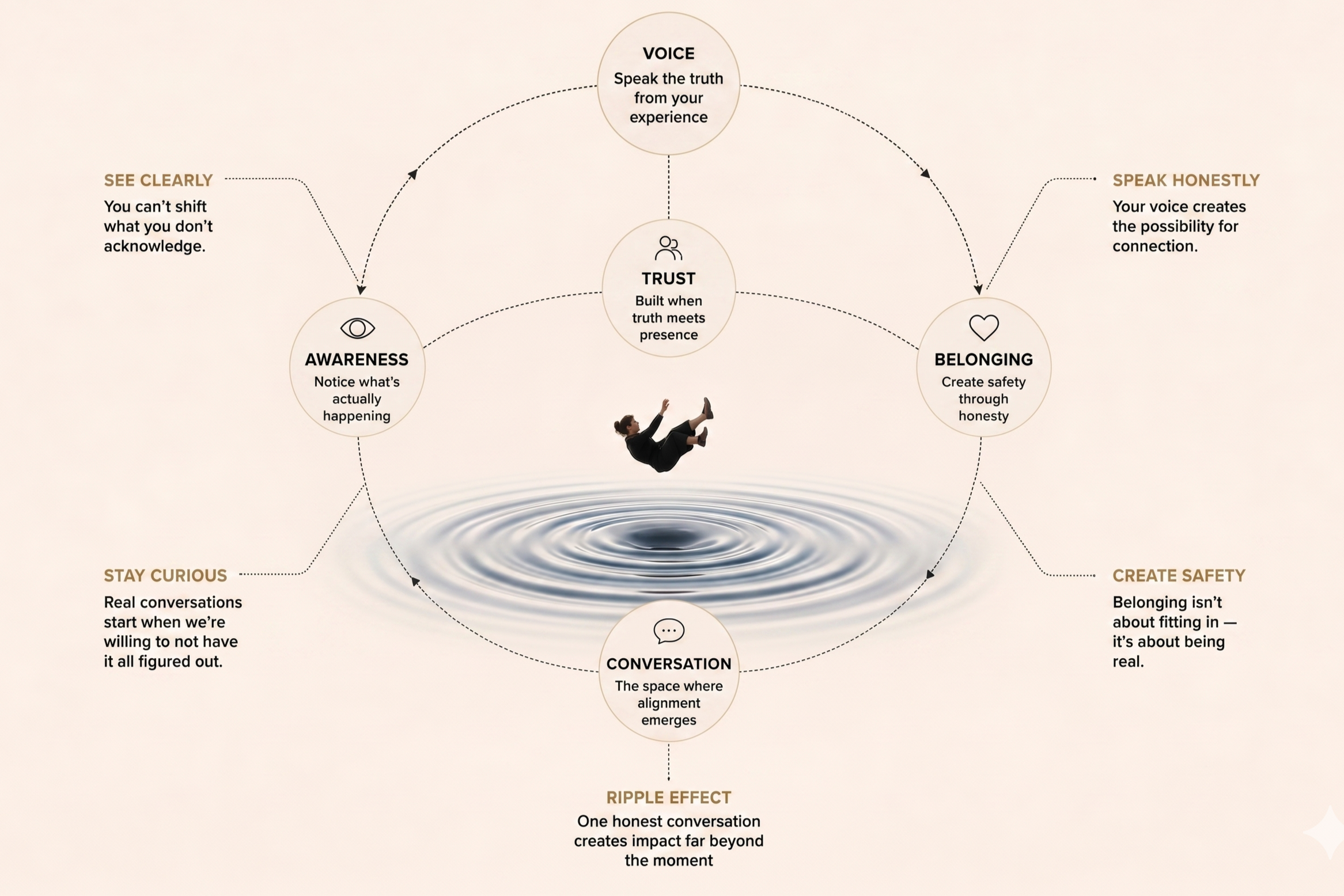
Awareness, noticing what's actually happening, is what makes voice possible. Speaking the truth from your experience creates belonging. Belonging, meaning safety through honesty rather than fitting in, opens real conversation. And conversation deepens awareness, so the cycle continues. Trust sits at the centre, built when truth meets presence. One honest conversation creates impact far beyond the moment.
Notice earlier than you think you need to. The contraction usually doesn't start in the conversation. It starts in the anticipation, sometimes days out, in the rehearsing and the dread. That's the easiest place to catch it, because you're not yet under the social pressure of another person's face. If you're rehearsing a conversation in the car, that's the moment to pay attention.
Find the sensation, not the story. When you check in, your mind will want to hand you an analysis. He's going to be defensive. This is going to go badly. Set that aside for a moment and look for the physical fact instead. Tight throat. Shallow breath. Something heavy in the chest. The Triangle of Awareness is the practice I teach for this, and it takes about twenty seconds. The sensation is more reliable information than the story, because the story is being generated by the sensation.
Say the smallest true thing. Not the whole speech. Not the perfectly constructed ask. One accurate sentence about what's happening right now. I've been putting off saying this.I notice I'm nervous, which usually means it matters to me. This does something specific in your body: naming a state reduces its grip, which is why it lowers the temperature in the room rather than raising it. It also tells the other person that something real is happening, which usually makes them more careful, not less.
Let the ask follow the truth, not precede it. Most of us do this backwards. We lead with the request, hedged into unrecognizability, and hope the other person infers the feeling underneath. Reversing the order works better. Once you've named what's present, the ask tends to come out plainly, because you're no longer trying to smuggle it in under something softer.
Separate the speaking from the outcome. This is the hardest part and the one most people skip. You are responsible for saying the true thing. You are not responsible for how it's received. A relationship that can only hold the smaller version of you was already resting on that arrangement, whether or not anyone named it. Finding that out is painful and it's also information you needed.
And know that it may not work the first time. You may say the true thing and get a bad response. You may say it badly. You may lose your nerve halfway and revert. That's normal, and it isn't a reason to stop. The nervous system learns this the way it learns anything, which is through repetition and through evidence, not through a single successful attempt.
Where this goes deeper
In sessions, this is often where the real work begins. Not in finding the right words for one hard conversation, but in understanding why a particular relationship, or a particular kind of moment, reliably triggers this contraction in you. Sometimes that pattern is recent. More often it's old, a part of you that learned, a long time ago, that the honest version of you wasn't the one that got to stay.
That's not something you have to figure out alone, and it isn't something that resolves through insight. It's something the body has to learn is no longer necessary, which is why somatic approaches matter here, and why healing has to reach the body rather than stopping at understanding.
If you find yourself rehearsing conversations you never quite have, or noticing the same contraction every time a particular relationship gets close to something real, that's worth exploring. Reach out if you'd like to talk about what that could look like.
Prompted by "The Ripple Effect: Finding Your Words Isn't the Problem" by Krista Berlincourt.