
The Triangle of Awareness: A Simple Practice for Noticing What's Actually Happening
There's a practice I teach in almost every therapy I do, and it's one of the most useful things I know.
It sounds absurdly simple. It's not. And once you have it, you have a tool that you can use for the rest of your life: in the middle of a difficult conversation, before making a decision you're not sure about, when a wave of anxiety arrives from nowhere, when you can't figure out why you snapped at your partner over something small.
The practice is often called the Triangle of Awareness. It's a teaching device that circulates widely in mindfulness-based work, and the underlying idea is central to programs like MBSR and MBCT, where attention is trained on thoughts, emotions, bodily sensations, and behavior together rather than one at a time.
At any given moment, three things are happening inside you: thoughts are running, emotions are moving, and sensations are alive in your body. Most of the time, you're aware of only one of them, usually the thoughts. The emotions and sensations are there too, doing significant work, but they're happening beneath the level of ordinary attention. And what your body and emotions are doing is often more important than what your thoughts are saying about it.
The practice is learning to notice all three.
The Three Channels
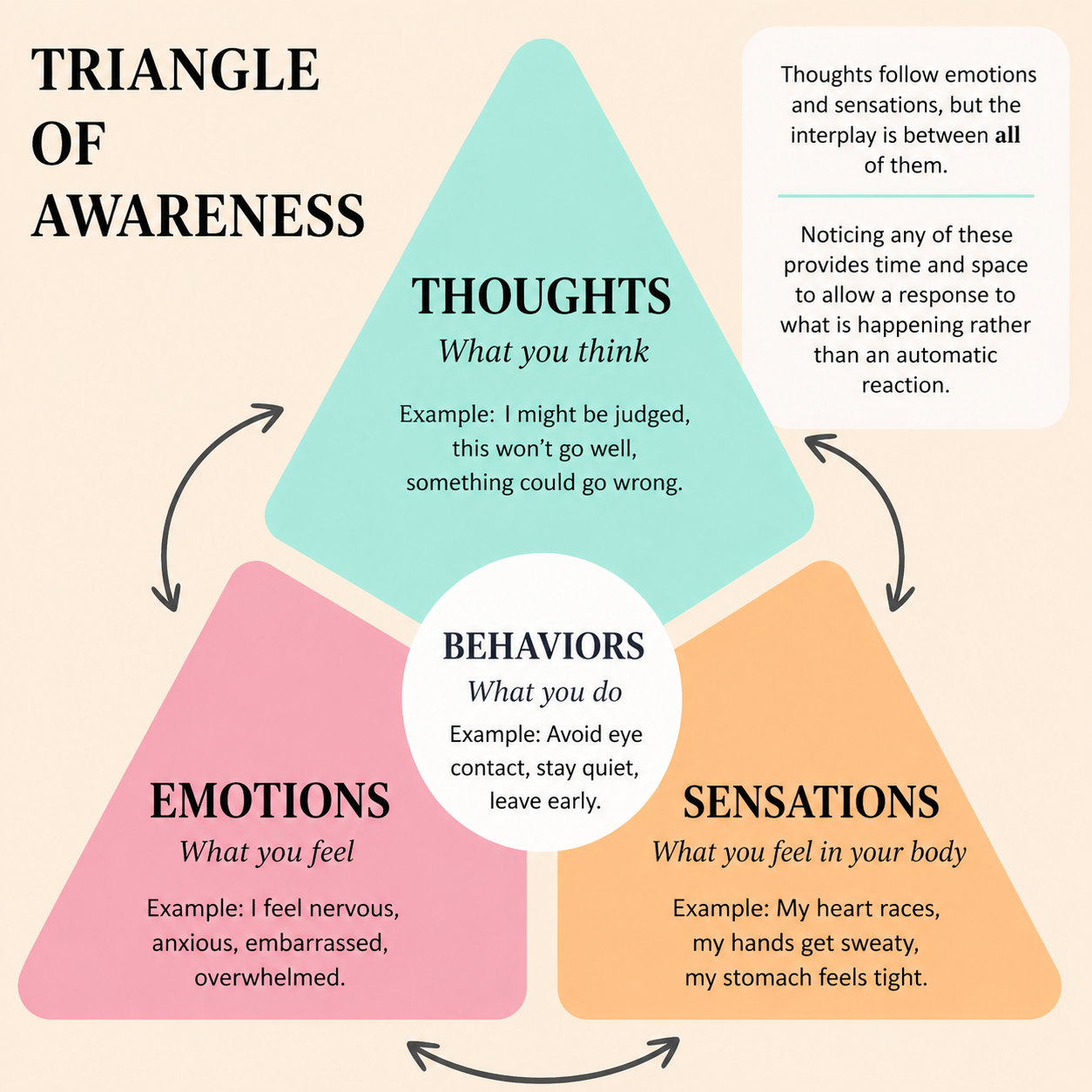
"Triangle of Awareness — thoughts, emotions, sensations, behaviors"
Think of it this way. Right now, in this moment, three streams of information are flowing through you:
Thoughts. What your mind is saying. The narration, the interpretation, the story about what's happening. I have too much to do today. This person is going to judge me. I should have handled that better. Why did she look at me like that? Thoughts are usually the loudest channel, and they're what most of us identify with as me thinking.
Emotions. What you feel. Anxiety, sadness, joy, anger, longing, tenderness, dread, embarrassment, hope. Emotions are usually less specific than thoughts and often present as a general felt tone. I feel off. I feel small. Something isn't right. Sometimes emotions are clear and named. More often they arrive as diffuse states you might not even notice until you look.
Sensations. What's happening in your body. Tight chest, shallow breath, warm face, clenched jaw, heavy limbs, restless legs, tension in the shoulders, softness in the belly, the ache behind your eyes, the flutter in your stomach. Sensations are the most concrete channel and, paradoxically, the one most people are least aware of moment to moment.
At the center of the triangle sits a fourth element: behavior. What you actually do. Withdraw, argue, snap, comply, leave the room, check your phone, go quiet, launch into overwork, pour a drink.
The insight the framework offers is this. Your behavior usually comes from your thoughts, emotions, and sensations acting together, and most of the time you're only tracking one of them. The others are shaping what you do without your awareness.
A note on names, because I use two triangles in my work and they're easy to confuse. This one is a noticing practice. The Change Triangle, which I write about in the post on suppressed anger, is a different framework about defenses, inhibitory emotions, and core emotions. Related territory, different tool.
Why This Matters
There's a specific moment this practice is designed for. It's the moment between something happening and your response to it.
Someone says something that stings. A colleague sends an email that lands wrong. Your partner makes a face you can't quite read. Your child asks something in a tone you don't like. In each of these moments, there's a tiny gap between the event and your response. Most of us don't experience the gap. We just react.
The reaction feels automatic because we're only aware of one channel, usually thoughts and sometimes emotions if they're intense, while the other channels are doing their work invisibly. The sensation of tightness in your chest tells your system this is dangerous. The emotion of shame that flickers through activates old defensive patterns. The thought that arrives, he doesn't respect me, feels like the truth about the situation, when it's actually one interpretation among many, produced by the underlying sensation and emotion your system was already running.
By the time you react, all of this has already happened. You're just following the momentum of the system.
The Triangle of Awareness gives you a way to open the gap. Not to eliminate the reaction, but to introduce a small pause. To notice, briefly, what's happening in each channel. To recognize that the felt urgency is coming from your body, that the emotion is old and familiar, that the thought is one interpretation and not the only one.
And in that noticing, something shifts. Not always dramatically. But enough that you have a choice you didn't have before. This is also why understanding a pattern often isn't enough to change it. Insight operates in one channel. The pattern is running in all three.
How to Actually Use It
The practice, in its simplest form, is this: several times a day, pause and check in with all three channels.
Not for long. Twenty seconds is often enough. You can do it while walking from your car to your office, while waiting for water to boil, while sitting in a meeting, while your child is talking to you. It's a micro-practice, not a formal meditation.
Ask yourself:
What am I thinking right now? Notice the actual sentences running through your mind. Not what you should be thinking. What you are thinking. Even if it's mundane. Even if it's harsh. Just observe it.
What am I feeling? Not the elaborate emotional story. The actual felt tone. Anxious. Restless. Content. Sad. Numb. Ashamed. Warm. If you can't name it, that's fine. Just notice the quality of what's here.
What's happening in my body? Scan quickly. Where's the tension? Where's the ease? What's your breath doing? Where is your weight? Is there a hollowness somewhere, a bracing, a lightness?
That's it. You don't have to do anything with what you notice. The noticing itself is the practice.
The point isn't to fix anything. It's to break the automaticity by introducing awareness across all three channels at once.
Why It's Harder Than It Sounds
I want to be honest about something. This practice sounds so simple that most people don't take it seriously. They try it a few times, notice that not much happened, and drop it.
Here's what to know.
The practice is training your attention to include channels it usually leaves out. Most of us have spent decades primarily identified with thought, with emotions felt only when they get loud enough to demand attention, and with sensation almost entirely offline. Learning to notice all three is like learning to tune three radios at once. It takes time before you can do it fluidly.
The first weeks often feel like nothing. You check in, notice you're thinking about work, notice that your shoulders are tight, notice you feel mildly anxious, and go back to your day. It seems too simple to be doing anything.
What's actually happening, underneath, is that your attention is being trained. The neural pathways for interoception, meaning awareness of the body's internal state, are being built up through repetition. The habit of pausing before reacting is slowly getting installed. You won't feel it happening most of the time. But if you do the practice for a few months, one day you'll notice yourself in the middle of a difficult conversation, aware of your tight chest, aware of the flush of shame, aware of the thought that's arriving, aware that you have a choice about how to respond. That's the practice working.
This is the same reason a mind that won't go quiet isn't a failed meditation. What you're building is the returning, not the stillness.
The other reason it's hard: many of us have been avoiding the emotion and sensation channels for a long time, sometimes for good reasons. Turning attention to what's actually happening in your body can be uncomfortable, especially if what's there is painful. If checking in with sensations reliably produces distress rather than curiosity, that's clinical information. It usually means there's material that hasn't been fully processed, and the practice may need to happen inside a therapeutic relationship rather than alone. Sometimes what surfaces is a nervous system that has been braced for a very long time, and that needs more than noticing.
What This Practice Isn't
It's worth naming what the Triangle of Awareness isn't, because it's often confused with other things.
It isn't cognitive-behavioral therapy. CBT works by identifying and changing thoughts. This practice isn't about changing anything. It's about observing what's already there. The channels aren't problems to fix; they're information to notice.
It isn't emotional processing. When you notice emotions in this practice, you're not trying to work through them or feel them fully. You're just registering that they're present. Deeper emotional work usually happens in therapy or in longer contemplative practice.
It isn't a substitute for feeling. Some people use awareness practices to observe their emotions from a safe distance, without ever fully feeling them. This isn't awareness in the useful sense. It's a subtle form of avoidance. The point is to be present with what's happening, not to observe it from above.
And it isn't a way to control your reactions. The practice doesn't eliminate difficult responses. It just opens a small gap in which choice becomes possible. Sometimes, having noticed the tight chest and the flush of shame and the thought that arrived, you still respond exactly as you would have. The point isn't perfect regulation. It's the recovery of choice.
Using This in Therapy
If you're in therapy, this practice can transform what happens in session.
When you arrive, take a moment before you sit down to notice all three channels. What are you thinking about the session? What are you feeling? What's happening in your body? This orients you to what's actually present, rather than launching immediately into narrative.
During difficult moments in session, when something a therapist says lands hard, when you feel yourself getting defensive, when tears arrive from nowhere, the practice gives you a way to slow down. Rather than being carried by the reaction, you can briefly check in: What am I thinking right now? What am I feeling? What's happening in my body? Naming these out loud, if it feels right, gives your therapist important information about what's actually alive for you.
This kind of sensation tracking is also the backbone of somatic EMDR, where noticing what's happening in the body isn't a preliminary step but the main channel the work runs through.
Between sessions, the practice supports integration. What we do in therapy often stirs up material that continues working underneath. Checking in with all three channels during the week, especially when things feel off, when old patterns emerge, when you notice yourself reacting in familiar ways, helps you track what's happening and bring it back into the next session with clarity.
A Closing Note
Most of the practices worth doing are simple. They don't require expensive equipment, elaborate preparation, or special conditions. They ask something more modest and more difficult: sustained attention to what's already here.
The Triangle of Awareness is one of these. Twenty seconds, several times a day, checking in with what your thoughts, emotions, and sensations are actually doing. Nothing complicated. Nothing dramatic. Just the slow cumulative practice of noticing across all three channels instead of only one.
If you do this for a month, you'll begin to feel the change. If you do it for a year, it becomes part of how you inhabit your life, a way of being present to yourself that was always available but that most of us never quite learned.
If you'd like a place to develop this practice, through therapy that takes both mindfulness and depth work seriously, you're welcome to book a consultation.