
Order, Chaos, and the Story of Becoming
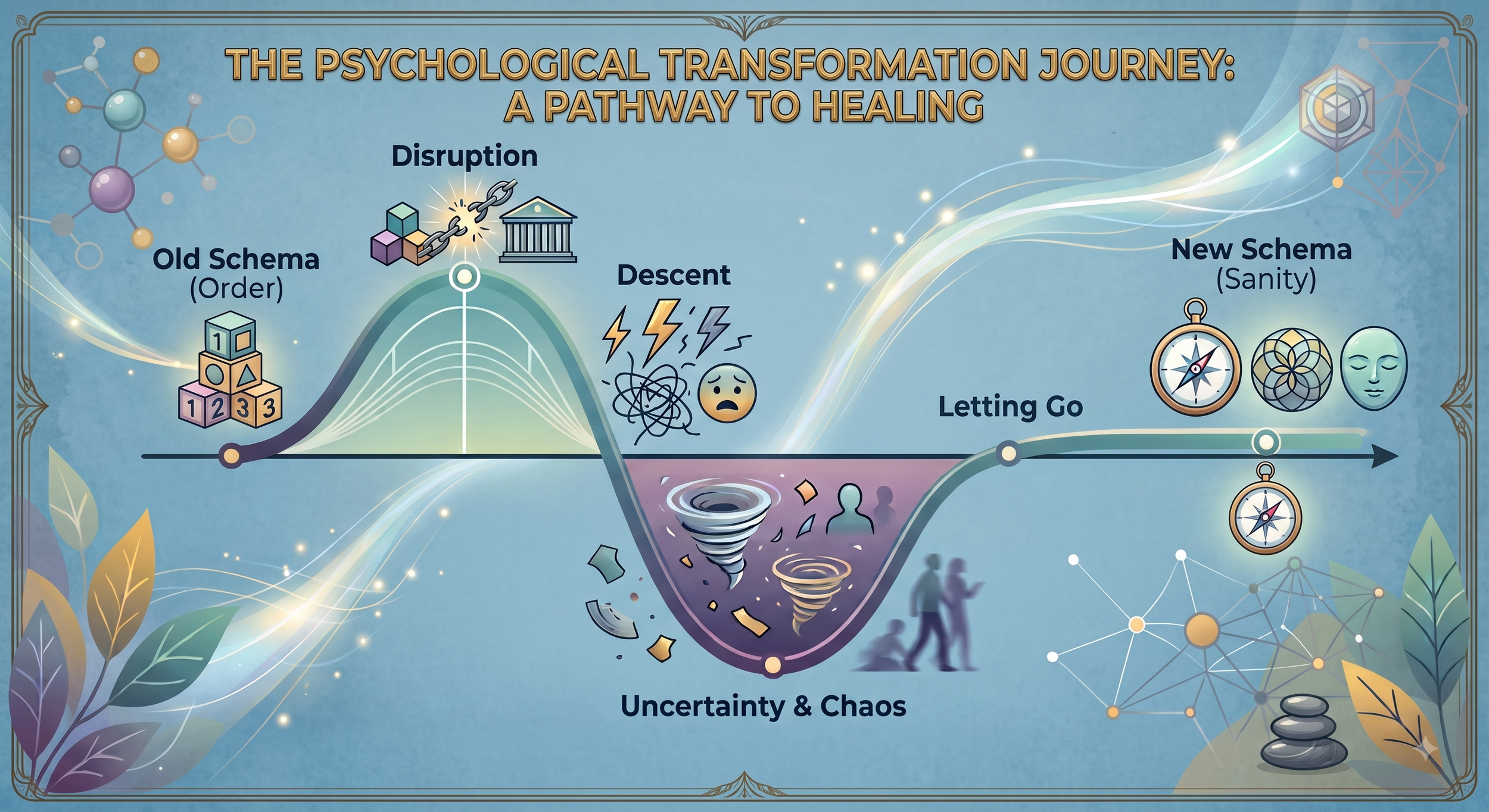
The arch of psychological transformation: old schema, disruption, descent, uncertainty & chaos (deathlike), letting go, new schema.
Most people come to therapy in the middle of something coming apart.
Sometimes it is loud: a marriage ending, a job lost, a diagnosis, a death. Sometimes it is quiet, harder to name; a life that looks fine from the outside but has stopped feeling like yours. Either way, there is usually a sense that the structure you were living inside has cracked, and you are not sure yet what, if anything, will hold.
It is worth knowing that this experience, disorienting as it is, has a shape. Across mythology, contemplative traditions, and what we understand about how the mind actually changes, the same pattern keeps appearing. Understanding it will not make a hard passage painless. But it can change your relationship to the pain, which turns out to matter more than we expect.
Two forces, and the line between them
Think of two poles.
At one end is order: structure, routine, the known. Order is what lets you function. It is the roles you have settled into, the beliefs you count on, the daily patterns that mean you do not have to decide everything from scratch each morning. We need order. Without it, life is chaos in the worst sense, unlivable, formless.
At the other end is chaos: the unknown, the unstructured, everything that has not yet been made sense of. We tend to hear the word as purely negative, but chaos is also where possibility lives. Nothing new ever came from the fully known. Every genuine change you have made required stepping, at least briefly, into territory you could not predict.
A life lived entirely in order becomes rigid. The structures that once protected you start to confine you. You are safe, and slowly, something in you goes quiet. A life lived entirely in chaos cannot hold together at all. Neither pole is where we grow.
Growth happens on the line between them. At the edge of order, right where the known meets the unknown, there is enough structure to keep you intact and enough openness to let something change. This is why so much of real transformation feels like standing at a threshold. You are, quite literally, at the edge of what you know.
The arc of becoming
When a life moves through genuine change, it tends to follow a recognizable arc. You can find versions of it in nearly every mythology and wisdom tradition, which is usually a sign that something true is being described.
It begins with stability. A known world, an established order. For a while it works.
Then comes disruption. Something breaks the order, by force or by a slow erosion you can no longer ignore. The old structure stops holding. This is the crack, and it is frightening precisely because order is what kept you safe.
Then descent. This is the hardest part and the part our culture least understands. Before the new thing can form, there is usually a period of not-knowing, of loss, of moving through territory without a map. Myths call it the underworld, the belly of the whale, the dark wood. It is not a detour on the way to transformation. It is where transformation happens.
Then a letting go. At some point in the descent, something you were holding onto, an identity, a belief about yourself, a version of your life, has to be released. This is rarely a decision so much as a giving way. It can feel like a kind of dying, because in a real sense something is ending.
And then, if the passage completes, return. Not back to where you started, but to a new order, wider than the one you left. You re-enter your life carrying something you did not have before. What was unbearable becomes, in time, part of the ground you stand on.
The reason this matters clinically is simple. When you are in the descent, it does not feel like an arc. It feels like an ending. Knowing the shape does not remove the difficulty, but it can keep you from mistaking the middle of the story for the end of it.
Why the nervous system fights the passage
If this arc is so universal, why is it so hard? Why do we cling to structures that are clearly no longer serving us, sometimes for years?
Part of the answer is that the mind is built to prefer the predictable. A known pain is, to the nervous system, often safer than an unknown relief. Your system would frequently rather run a familiar, even painful pattern than face the uncertainty of a new one. The familiar is at least survivable, by definition, since you have survived it. This is not weakness or self-sabotage. It is a protective system doing its job a little too well. (I write more about this in Why the Brain Prefers Familiar Suffering, if you want the fuller version.)
This is also why the descent is so often resisted, delayed, medicated, outrun. Everything in us wants to skip it, to get to the resolution without passing through the not-knowing. But the letting go is not optional. You cannot reach the new order while still gripping the old one. The work of therapy, much of the time, is helping someone stay present through the part they most want to escape, so that the passage can actually complete instead of stalling halfway.
And it is worth saying plainly, not everyone needs to go looking for chaos. Many people arrive already in it, flooded, with too little order to stand on. For them the work runs the other direction, toward enough stability to make the chaos survivable. The edge we are aiming for is not maximum disruption. It is the workable border between structure and openness, and where that border sits is different for each person and each season of a life.
What this asks of you
If you are in the middle of one of these passages right now, a few things are worth holding.
The disruption is not proof that you did something wrong. Often it is proof that something in you outgrew the structure you were living in.
The descent is not a sign you are failing. It is, more often, the actual location of the change you are looking for. The discomfort of not-knowing is not the obstacle to transformation. It frequently is the transformation, still in process.
And you do not have to make the passage alone. Much of what makes the descent bearable is not solving it faster but being accompanied through it, by people, by practice, by a steady relationship that can hold what is emerging while it takes its shape. This is a great deal of what good therapy is. It is not a shortcut around the hard middle, but company through it, and enough steadiness at the edge that you do not have to choose between falling apart and staying the same.
The story of becoming is old, and it is yours. If you are somewhere in the middle of it and would like a place to do that work, you're welcome to reach out.