
What Is Internal Family Systems?
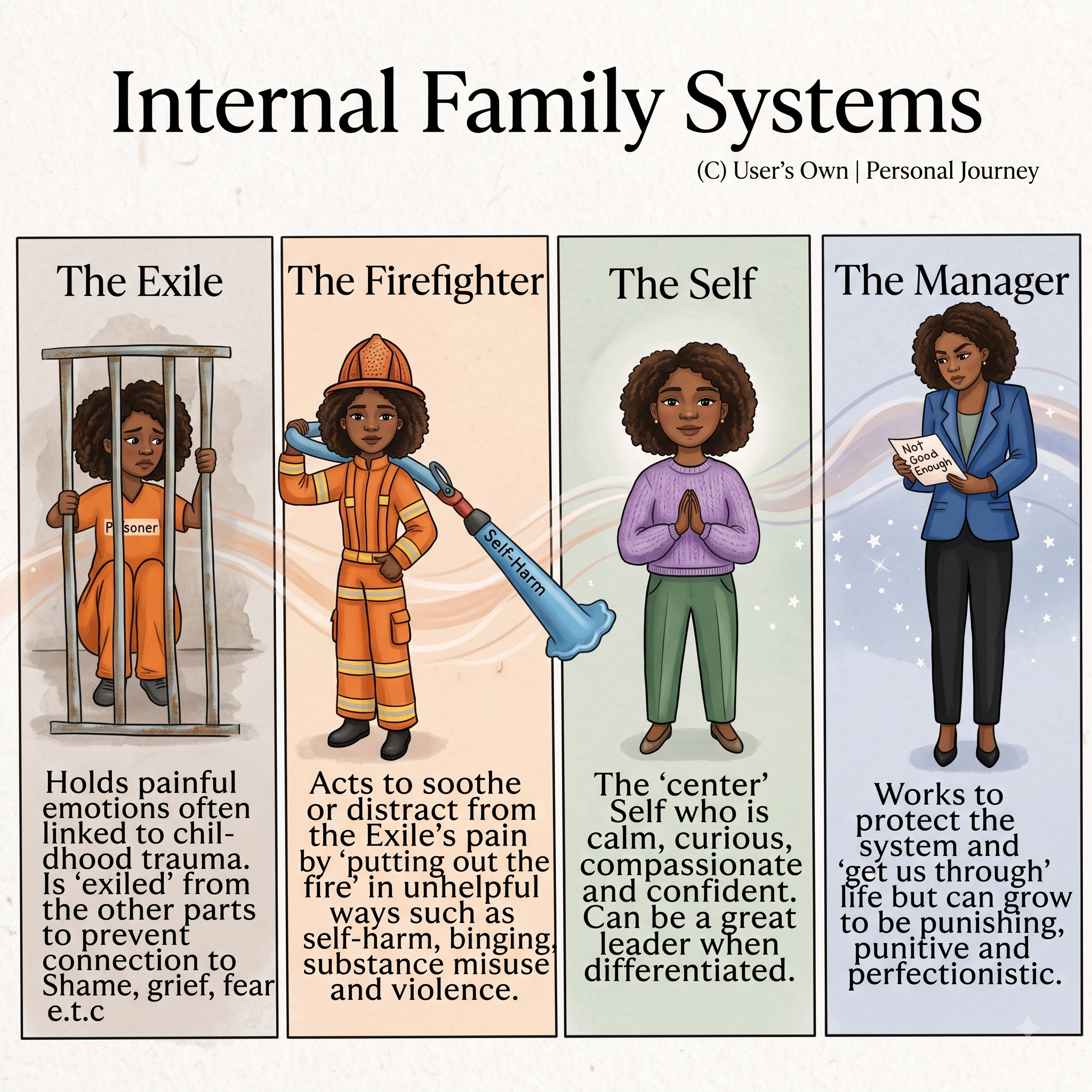
There's a model of the mind that, once you start using it, becomes hard to see things any other way.
It's called Internal Family Systems, or IFS. It was developed by psychologist Richard Schwartz in the early 1980s. Schwartz began as a family therapist, working with the difficult dynamics that play out between people in a household. Listening carefully to his clients, he noticed they kept describing something similar happening inside themselves. Different voices. Different reactions. Parts of them that wanted different things, that argued, that took over, that hid.
He started asking his clients about these parts directly. What surprised him was how much detail they could give. Each part had a history, a role, a job it had taken on, a relationship to the other parts. The internal world, he realized, looked a lot like the families he had been working with. It was a system of distinct members, each with its own perspective, all trying to coexist.
Over the decades, this became one of the most influential models in modern psychotherapy. IFS is now recognized as an evidence-based practice, and recent research points to its promise for PTSD, depression, and chronic pain. I want to walk through what it actually is, because for anyone sitting with their own difficult inner experience, this framework offers something genuinely useful.
The mind as a system, not a monolith
Most of us were raised on a particular assumption about the mind. There's one "you" inside, who has thoughts and feelings and makes decisions. When that "you" feels conflicted, wanting one thing and doing another, knowing better and behaving worse, we tend to call it a failure of willpower or self-knowledge.
IFS proposes something different. The mind isn't a single voice with occasional conflicts. It's a system of distinct parts, each with its own perspective, history, and concerns. What feels like confusion or self-contradiction is often just several parts active at once, each with a different agenda.
You've probably noticed this without naming it. A part of you wants to go to bed early. Another part stays up reading. A part of you wants to leave a job. Another part is afraid of the change. A part of you knows you should call your father. Another part is still angry at him. Most of the time we treat these as opposing impulses inside one unified self. IFS treats them as distinct parts in genuine relationship with each other, each with its own legitimate concern.
This isn't a fringe idea. Many therapeutic traditions have noticed something similar. What IFS adds is a precise, workable model of how the system is organized.
The three kinds of parts
In Schwartz's framework, the parts fall into three broad groups.
Exiles. These parts carry pain, usually old pain, often originating in childhood. They hold the grief, fear, shame, or loneliness that the system couldn't fully process at the time. To protect the rest of the system from being overwhelmed, exiles are usually pushed out of awareness. They don't disappear. They're held away, often for decades.
Managers. These parts work to keep the exiles from being triggered. They organize your life. They keep you productive, perfectionistic, controlled, alert. They run the inner critic that pushes you to do better and the overthinker that anticipates every threat. Their job is to make sure the wounded exiles stay contained, by managing the outer world so carefully that the underlying pain never gets stirred up.
Firefighters. These are the emergency responders. When the managers fail and exiled pain starts to surface, firefighters rush in to put the feeling out fast, by whatever means work. They show up as sudden anger, substance use, dissociation, binge eating, compulsive scrolling, impulsive choices. They aren't trying to ruin your life. They're trying to stop you from feeling something the system has decided would be unbearable.
Here's the insight that makes IFS so powerful in practice. None of these parts are bad. They're all trying to help, in the only way they know how. They took on extreme roles because the system needed them to at some point. The work isn't to get rid of parts. It's to understand them, hear them, and let them gradually take on healthier roles. This is a very different stance than the one many of us carry toward our own patterns, and part of why so much lasting change depends on more than insight.
The Self at the center
Underneath the parts, IFS proposes, there is something else. It's called the Self.
The Self is not a part. It's the core of who you are. According to Schwartz, it's present in everyone, including people with the most severe trauma histories. The Self carries qualities he grouped into what he calls the eight Cs: curiosity, calm, clarity, compassion, confidence, courage, creativity, and connectedness.
When the Self is in the lead, when none of the protective parts are fully in charge, the system can rest. Parts can communicate. Old wounds can be approached with care rather than avoidance. The whole inner ecosystem becomes more flexible.
Most people, most of the time, are not in Self. They're blended with one part or another. Taken over by the manager who runs everything. Fused with the anxious part. Identified with the inner critic. The work of IFS is helping the Self take leadership, so that parts can be in relationship with the Self rather than running the whole system.
This is harder than it sounds. Many people, when they first meet IFS, can't easily access the Self at all. The protective parts have been in charge for so long, and so completely, that the Self has become hard to reach. Part of the slow work is uncovering the Self that has been there the whole time, underneath the layers of protection.
How IFS therapy actually works
In a session, the work is direct and experiential. I might invite you to notice a part of you that's been activated. It may show up as a felt sense in the body, an image, a voice, an emotion. Rather than judging it or trying to argue with it, you turn toward it with curiosity.
What does this part want you to know? What has it been doing for you? How long has it been here? What is it afraid would happen if it stopped?
Surprisingly often, the part has clear answers. Once it feels seen and heard, it tends to soften. It may show you what it's been protecting, usually a younger, more vulnerable part holding old pain. The work then moves to that deeper layer. Meeting the exile. Witnessing what it has carried. Allowing it to be released from the burden it took on.
This release is called unburdening. When an exile is unburdened, the system reorganizes around it. The managers and firefighters that have worked so hard to contain it can finally relax. The whole inner family grows more peaceful.
This can sound abstract. In practice it's often immediate and deeply moving. People who have done years of talk therapy without reaching a particular pattern can sometimes meet it directly through IFS, not because the pattern was simple, but because IFS reaches it through a different door. Because it works in the body and not just the intellect, it sits naturally alongside the other body-based ways that healing has to reach more than the thinking mind.
Why I use IFS in my work
IFS belongs to a family of depth-oriented approaches that share an orientation. They don't try to fix or eliminate. They work to understand the system and help it reorganize.
This fits how I practice. Much of my work is relational and depth-oriented, and a great deal of what makes it possible is a steady, trusted relationship that can hold what emerges. Parts don't reveal themselves to a stranger reading from a checklist. They soften in the presence of someone who is genuinely there. IFS gives that relationship a clear structure, a way of turning toward the inner world with curiosity instead of judgment, so the protective parts can begin to trust that it's safe to let go.
For clients dealing with anxiety, self-criticism, old relational wounds, or patterns that haven't shifted despite real effort, IFS often reaches something that other approaches circle around. It doesn't ask you to be different. It asks you to get to know who's already there.
A closing thought
What I find most moving about IFS is its underlying premise. Beneath all your protective patterns, beneath the wounded parts, beneath everything that has hurt you and everything you've done to protect yourself from being hurt, there is something undamaged. A core of curiosity, compassion, and presence that has been with you the whole time.
For people who have lived inside chronic suffering, this can be hard to believe. The Self can feel inaccessible, even mythical. But in the IFS view it is always there. The work is not to create something new. It's to clear enough space for what has always been present to take the lead again.
Not all at once. Not without setbacks. But steadily, with practice and support, the parts that have been protecting and exiling can be welcomed home, and the Self that was always there can begin to lead.
If you'd like to explore this kind of work, you're welcome to reach out.
For a fun and readable book on Internal Family Systems see “Quieting the Storm Within” by J. Ashley T. Booth.