
The Four Pillars of Good Psychedelic Care
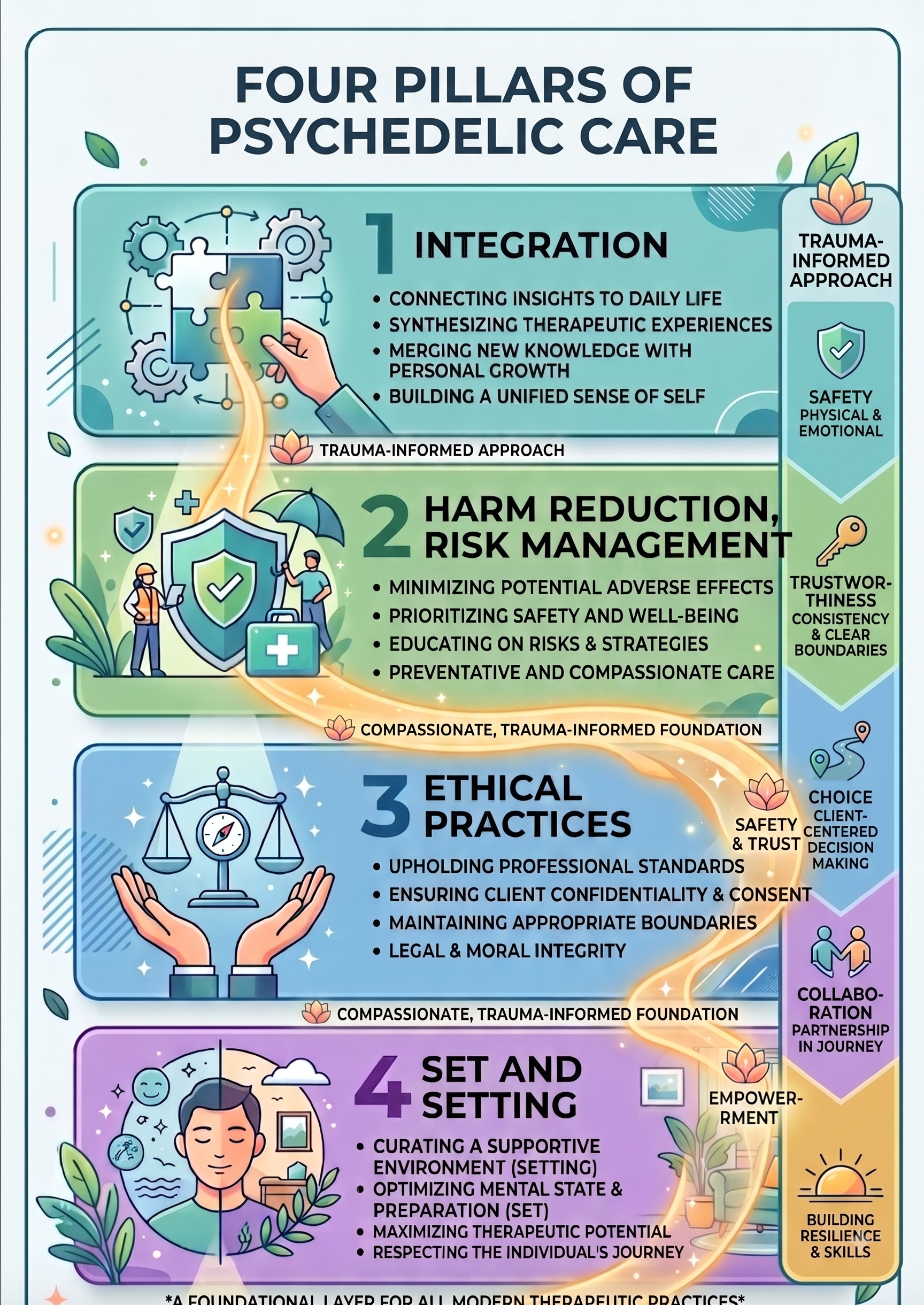
If you've been reading my blog, you've probably noticed I keep returning to a few themes when I write about psychedelic work: integration, risk, ethics, the nervous system. They're not separate topics. They're four interlocking parts of what I think makes this work either truly helpful or quietly harmful.
I want to lay them out together in one place, partly so you can see how they fit, and partly because I think anyone considering ketamine-assisted therapy, psychedelic integration, or any related work deserves a clear framework for evaluating what they're walking into.
These are the four pillars I think of as foundational. Without all four, something important is missing.
1. Transformation Requires Integration
Insight alone doesn't create change.
This is the one I come back to most often, because it's the place where the most well-intentioned psychedelic experiences quietly fail. People have a profound session, see something true about themselves, leave believing their life is about to be different, and then the insight slowly fades.
The work of integration is what bridges the gap. It moves an experience along a sequence: from the experience itself, to the meaning you make of it, to the actions you take in your life, to the embodied reality of living differently. None of those steps is automatic. Each requires attention, conversation, and time.
Integration isn't a single phase that ends after a few weeks. It's an ongoing process that touches your psychological life, your relationships, your body, the way you spend your days, and the meaning you make of being alive. When that process is given real space, the experience has a chance to become something you can actually live. When it's skipped, even powerful experiences tend to dissolve back into the patterns they briefly disrupted.
If you'd like to go deeper on this: Real Work Begins After the Journey and Why Insight Alone Doesn't Always Lead to Change.
2. Risk Is Real, But Context Shapes Outcomes
Psychedelics are neither inherently safe nor inherently dangerous. They are powerful, and the conditions in which they're used determine which direction the power flows.
The research keeps pointing to the same factors. Risk goes up when there's no preparation, when emotional support is missing, when someone is destabilized before they begin, when medication interactions are ignored, when dose isn't appropriately matched to the person. Risk goes down, significantly, when those conditions are reversed.
This is part of why I'm cautious about the way some psychedelic therapy is being marketed. The medicine itself is often presented as the active ingredient, with everything around it framed as supportive detail. But the data points the other way. Safety in psychedelic work isn't pharmacological. It's relational and contextual. It comes from the people, the preparation, the environment, the relationship, far more than from the molecule.
If you'd like to go deeper on this: How Common Are Bad Trips, Really? and The Hidden Risks of Ketamine Therapy.
3. Ethical Practice Means Supporting Without Controlling
There's a particular ethical tension in this work that I take seriously.
Some of the people I see have done their experiences within fully legal clinical frameworks. Some have done them in legal gray zones: retreats, ceremonies, contexts where the legal status varies. People come to integration work from many different paths.
My role doesn't change based on how the experience came to be. I provide psychotherapy. I don't administer substances. I support reflection and integration without facilitating illegal activity. I respect your autonomy as an adult making decisions about your own body and your own life, while keeping clear about what I do and don't do.
This isn't a bureaucratic distinction. It's a real ethical commitment. It allows me to meet you where you actually are, rather than where the law would prefer you to be — without compromising my integrity, your safety, or the integrity of the work itself. Strong professional boundaries aren't restrictive in this work. They're what allow the work to be genuinely useful.
If you'd like to go deeper on this: What Psychedelic Integration Therapy Is (And What It Isn't).
4. The Nervous System Is the Real "Setting"
You may have heard the phrase set and setting , the idea that what shapes a psychedelic experience is your inner state going in (the "set") and the environment around you (the "setting"). Most discussion of setting focuses on the external: lighting, music, physical space, who else is in the room.
The trauma-informed perspective reveals something deeper: the most important "setting" isn't the room. It's your nervous system. And the regulated nervous system of the practitioner sitting with you.
This is why I work the way I do and why I think it matters that any provider working with psychedelic medicine knows how to do this. A few principles:
Trauma is often, at its core, the experience of losing agency. Trauma-informed work consistently restores choice: about what to talk about, when to slow down, when to stop. That restoration is part of how healing happens.
Co-regulation is faster than self-regulation. When your nervous system is in distress, the steady, attuned presence of another person can help your system settle in ways that no internal technique can match, at least not in the moment.
Presence and attunement matter as much as technique, and often more. The practitioner's own regulated nervous system becomes one of the most powerful tools in the room. The technique can be perfect, and if the person delivering it is dysregulated, the work won't land. The technique can be modest, and if the person delivering it is genuinely present, the work can go remarkably deep.
If you'd like to go deeper on this: Why Psychedelic Therapy Has to Be Trauma-Informed and Why Healing Has to Reach the Body.
How These Pillars Fit Together
These four don't really stand alone. They support each other.
Integration depends on a trauma-informed approach, because what surfaces from a journey often needs careful, paced, body-aware work to be metabolized.
Risk reduction depends on integration, because a difficult experience that gets properly integrated often becomes meaningful, while one that doesn't can stay difficult for years.
Ethical practice depends on a clear understanding of all the others, because boundaries are easier to hold when you know what the work actually requires.
And nervous-system-aware practice depends on ethics, because trauma-informed care without strong professional boundaries can drift into something more murky — and people who have already been through enough don't need their healing relationship to be one more place where the rules are unclear.
When all four are in place, psychedelic work has a real chance of being what it can be at its best: not just an intense moment, but a sustainable path toward becoming more whole.
When even one is missing, something of the work is at risk.
What I Want You to Take From This
If you're considering ketamine-assisted therapy, psychedelic integration, or any related work, this is what I'd hope you'd hold in mind:
The medicine is part of the picture, not the whole of it.
Integration matters as much as the experience itself.
The conditions around the work, preparation, support, environment, relationship, determine more about safety and outcome than the substance does.
The ethical clarity of your provider matters. So does their nervous system.
You deserve someone who takes all four pillars seriously, who can hold each of them well, and who treats this work with the care it deserves.
If you'd like to talk about what KAP or integration work could look like for you, I'd be glad to hear from you. You can book a free consultation here.